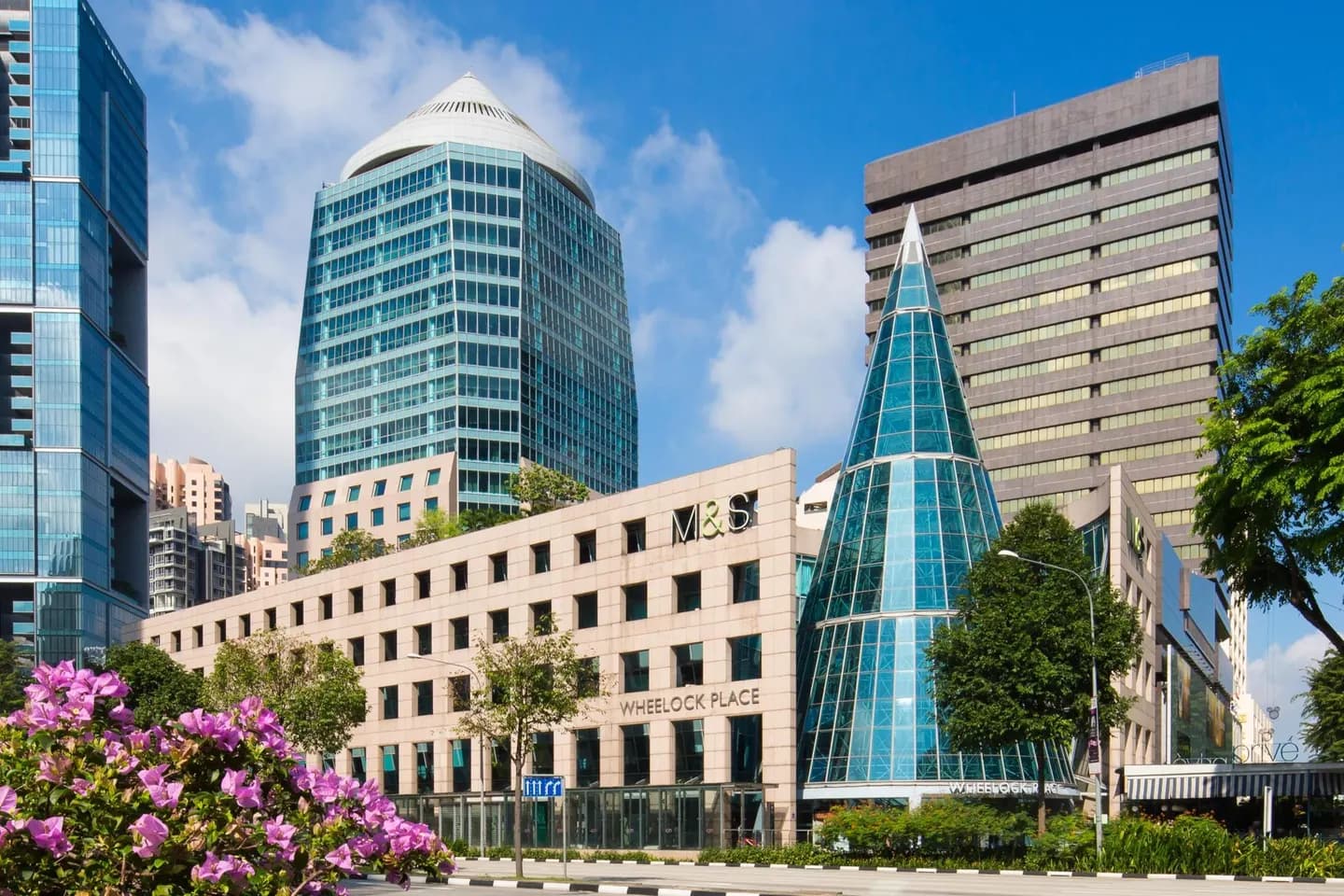
Hongkong Land has agreed to buy Wheelock Place, a landmark tower on Singapore's Orchard Road, for about 1.1 billion Singapore dollars, or roughly 900 million US dollars. The seller is Wharf Real Estate Investment Company, the Hong Kong group controlled by billionaire Peter Woo, and the deal is expected to close in August. For Hongkong Land, the property arm of the Keswick family's Jardine Matheson, the purchase is a statement of intent on the most prestigious retail address in the country.
The building is a familiar sight to anyone who has walked Orchard Road. Wheelock Place rises 21 storeys and holds around 43,000 square meters of gross floor area, split between office floors above and a retail podium below. Acquiring it hands Hongkong Land an immediate foothold in a precinct where trophy assets almost never trade, which is much of the point.
A new fund makes its first move
The money is not coming straight off Hongkong Land's own balance sheet. The purchase runs through the Singapore Central Private Real Estate Fund, a vehicle the company launched in February with about 8.2 billion Singapore dollars of assets under management. Hongkong Land holds the majority stake, sitting alongside outside investors that include the Qatar Investment Authority, one of the world's largest sovereign wealth funds. Wheelock Place is the fund's first acquisition since it opened for business.
The deal lifts the fund's assets to roughly 9.4 billion Singapore dollars and moves it toward a five year goal of at least 15 billion. Its existing holdings are among the most prized addresses in the city, including stakes tied to Marina Bay Financial Centre and One Raffles Quay. Adding Wheelock Place extends that collection from the downtown financial core into the retail heart of Orchard Road, broadening the fund from pure office exposure toward a mix that leans on shopping and tourism as well.
Michael Smith, chief executive of Hongkong Land, framed the purchase as exactly the kind of asset the fund was built to chase. The fund, he said, was created to acquire properties of a calibre that rarely reach the market, and Wheelock Place fits that description, marking the group's entry into the strategic Orchard Road precinct and deepening its commercial presence in Singapore. It is the language of a buyer that intends to keep spending in the city rather than dabble.
Recycling capital, not just deploying it
The Wheelock deal is one piece of a larger reshuffle Smith has led since taking the top job in 2024. Hongkong Land has committed to recycling as much as 10 billion US dollars of capital by 2035, freeing money from mature assets to fund fresh acquisitions, portfolio upgrades, and share buybacks. By June the company had already recycled about 3.7 billion of that target, and the pattern of its recent moves shows where the freed up cash is heading.
On the selling side, the group offloaded Singapore residential developer MCL Land to Malaysia's Sunway Group last September for 579 million US dollars, trimming its exposure to homebuilding. On the buying side, it has been leaning into Singapore commercial property, taking a 422 million US dollar stake in Suntec REIT in March as a bet on the city's property upswing, while separately pouring around 1 billion dollars into upgrading its retail malls in Hong Kong's Central district. Wheelock Place is the boldest expression yet of that tilt toward Singapore.
Why Singapore keeps drawing the money
The transaction says something about where large investors feel safe right now. Singapore has spent the past few years absorbing capital from across the region, prized for its stability, its rule of law, and its status as a neutral base at a moment when money is wary of concentration risk elsewhere. A fund that pairs a Jardine Matheson operating company with Qatari sovereign capital, then spends its opening move on Orchard Road, is a compact illustration of that flow, global institutions choosing the city as the place to hold long dated property.
There are reasons to stay measured. Orchard Road retail has had to reinvent itself as shopping habits shift online and as tourist spending patterns change, and paying up for a trophy tower is a bet that prime, hard to replace locations will hold their value even as secondary retail struggles. For Hongkong Land, that is a bet it is clearly willing to make, and for the wider region it is a useful signal. When patient global capital is still competing to own the best addresses in Singapore, the city's role as Southeast Asia's safe deposit box for real estate looks intact for now.