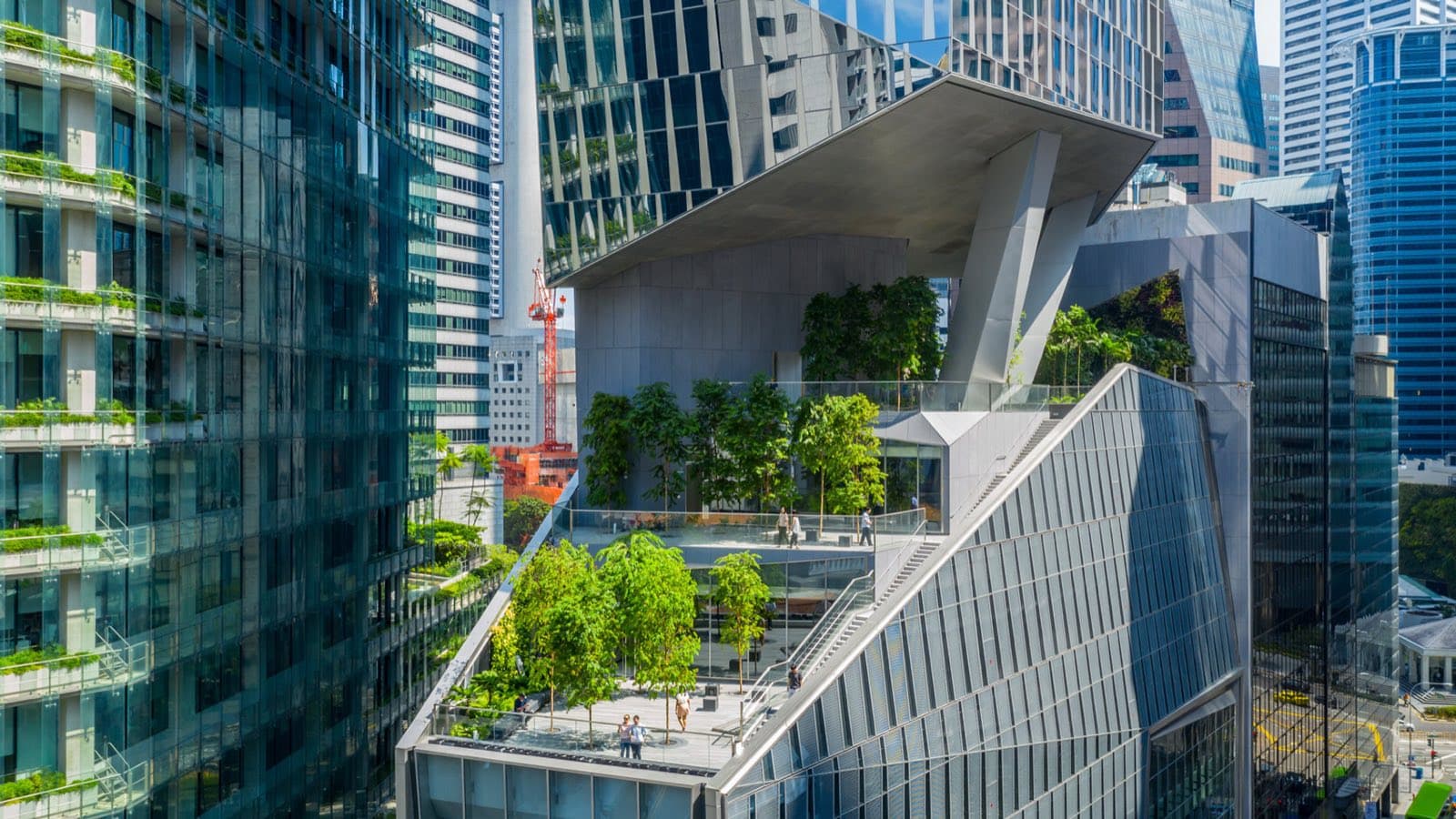
Fly into Singapore and the skyline looks less like a wall of glass and steel than a set of hanging gardens. Office towers sprout planted terraces halfway up their height, apartment blocks trail vines down their facades, and hotels hide entire groves on their roofs. The effect is deliberate, and it is the product of decades of policy rather than fashion.
The roots go back to 1965, when the newly independent city state set out to become a Garden City. What began as a campaign to line roads with trees has since hardened into a planning philosophy that treats greenery as infrastructure, on the same footing as roads, drains and power. Over time the slogan evolved from Garden City to a City in a Garden, and more recently to a City in Nature.
Rules that make greenery a requirement
The most powerful lever is a simple principle written into building rules. If a developer covers a patch of open ground with a tower, the lost greenery has to be replaced somewhere in the project, usually by climbing up the building itself. That has turned sky terraces, planted balconies and green roofs from luxuries into a practical way to satisfy the numbers.
Two tools do most of the work. A programme known as LUSH, short for Landscaping for Urban Spaces and High Rises, guides developers on where and how to add gardens in dense districts. Alongside it, a green plot ratio measures how much planted area a project delivers, so a building can be judged not just on the floor space it sells but on the landscape it gives back.
Money to make it happen
Rules alone rarely move developers, so the state also pays. Since 2009 the National Parks Board has run a Skyrise Greenery incentive that covers up to half the cost of installing rooftop and vertical planting. More than a hundred projects have tapped it, helping owners justify the upkeep that living walls and roof gardens demand. Green building rating systems add another nudge, rewarding towers that pair planting with daylight and direct views of nature.
Showpieces in the skyline
The results have become landmarks. CapitaSpring, a tower in the financial district, carries around eighty thousand plants spread across its fifty one floors, with green pockets at its base, middle and crown. The Parkroyal on Pickering hotel packs more than one hundred and sixty thousand square feet of sky gardens, cascading planters and waterfalls, an area more than twice the size of the land it sits on.
More than a pretty facade
The greenery does practical work. Plants shade glass and concrete, cooling buildings and easing the urban heat that bakes tropical cities, which in turn trims the energy spent on air conditioning. The gardens soak up rainfall, soften noise, shelter birds and insects, and give office workers and residents a rare dose of nature at height.
For a country with little land and a hot, wet climate, the strategy is also a form of branding. Singapore has turned its constraints into a selling point, marketing itself to companies and tourists as proof that a dense, high rise city can still feel green. As other crowded cities hunt for ways to cool down and calm their streets, Singapore's rulebook for wrapping towers in plants is drawing a growing audience.