Governments Have Pledged $65 Billion for Critical Minerals, and It's Still Not Enough
Public financing commitments for critical minerals in advanced economies hit roughly $65 billion in 2025, four times 2023 levels, but most of it hasn't been spent, private investment actually fell, and the total represents only a fraction of what's needed to meet surging demand from batteries, AI, and defense.
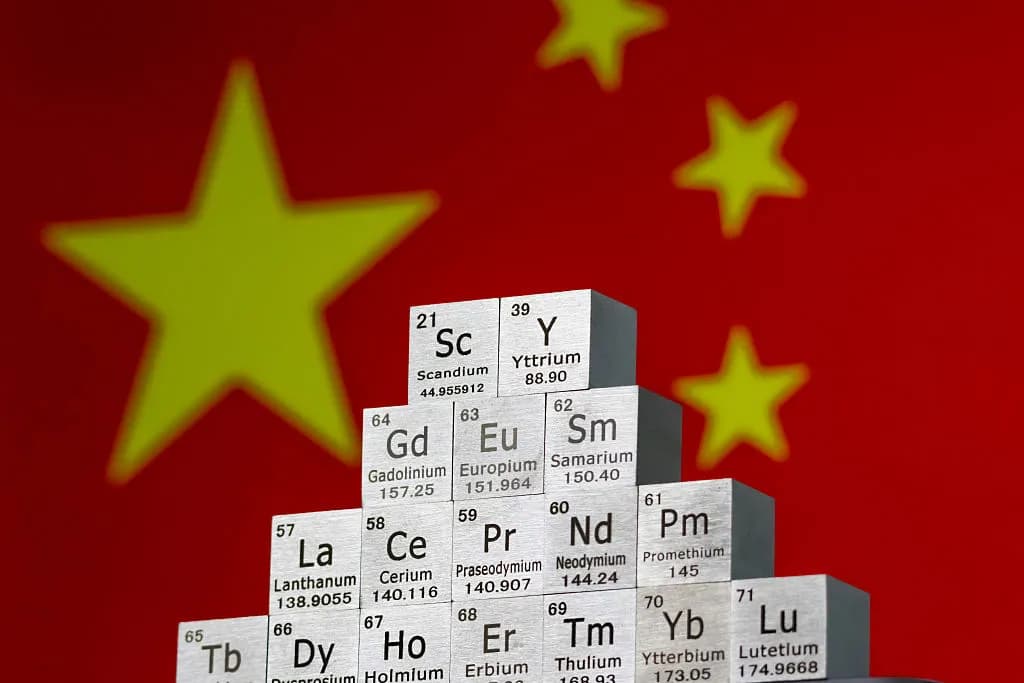
Metal cubes stamped with rare earth element symbols stacked in a pyramid in front of a Chinese flag · Source: Cheng Xin/Getty Images AsiaPac
Public finance commitments to critical minerals from advanced economies reached roughly $65 billion in 2025, more than four times the level pledged just two years earlier, as governments race to secure supplies of the materials that underpin everything from electric vehicle batteries to advanced chips. Most of that money, notably, has not actually been spent yet, which leaves a wide gap between the scale of the announcements and the scale of the mines, processing plants, and refineries that would actually need to get built.
Three demand waves hitting at once
The urgency behind the funding surge comes from three overlapping sources of demand rather than one. Battery production and broader electrification are projected to drive critical minerals demand up roughly twentyfold by 2040, the single largest force at work. Layered on top of that, the global AI infrastructure buildout is expected to roughly triple demand for these materials, and rising defense spending worldwide is projected to roughly quadruple it. Any one of those trends alone would justify serious government attention; having all three accelerate simultaneously is what has turned critical minerals from a niche policy concern into a headline-level priority.
A catalyst, not the whole solution
Even at $65 billion, public money is designed to function as a catalyst for private investment rather than cover the need outright, and by most estimates it represents only about one-tenth of the total capital required to meet projected critical minerals demand through 2040. That math only works if government spending successfully pulls in several times its own value in private capital behind it, a bet that depends heavily on whether investors see these projects as durable, well-governed, and genuinely profitable rather than politically driven.
Private capital is moving the other way
That bet looks shakier given what private investors actually did in 2025: overall critical minerals investment fell 9% for the year, ending a multi-year run of growth, as geopolitical tensions and price volatility made investors more cautious even as underlying demand kept climbing. The split is telling, governments are leaning in harder than ever on critical minerals even as the private capital meant to multiply that public spending pulled back, a mismatch that undercuts the premise the entire funding strategy is built on.
Oversight funding is shrinking as project funding grows
A separate risk is building beneath the headline numbers: development finance for mines, processing facilities, and related infrastructure is expanding at the same time that funding for transparency, regulatory capacity, civil society oversight, and community participation is being cut. Pouring money into extraction and processing capacity while starving the oversight mechanisms meant to keep those projects accountable is a combination that has historically produced exactly the kind of community conflict, environmental disputes, and delays that slow projects down rather than speed them up.
The backdrop this all plays out against
Much of this funding rush is implicitly a response to how concentrated global critical minerals processing, rare earth elements especially, already is in a small number of hands, China chief among them. The $65 billion pledged so far is a meaningful first step toward building alternative supply chains, but set against both the scale of projected demand and the head start that existing dominant producers already have, it looks less like a solved problem and more like the opening bid in a competition that is going to run for years.
Behind Indonesia's threatened MSCI downgrade and a stock rout that has wiped out roughly $57 billion from the country's richest tycoons sits a long-tolerated pattern: small-cap 'gorengan' stocks whose prices are pumped through wash trading, including one obscure company that rallied nearly 5,000% in about seven weeks.
Vietnamese real estate transactions slowed to their weakest pace since the pandemic in the third quarter, as Savills data shows Hanoi apartment prices have climbed nearly two and a half times since 2021, pushing homeownership further out of reach for ordinary buyers.
A proposal from index provider MSCI to strip Indonesia of its emerging-market status, and drop it straight to standalone status, sent the Jakarta Composite Index into its steepest one-day fall in nearly three decades, with billions more in foreign money now at risk.
Indonesia's sovereign wealth fund Danantara says it will put $5 billion into domestic businesses over the next six to nine months, a show of support that lands just as a proposed MSCI index downgrade has knocked billions off Jakarta's stock market.
Thailand hosts the IMF and World Bank's annual meetings for the first time in more than three decades, drawing over 15,000 delegates to Bangkok the same week Anthropic opens a Singapore office and Japan's auto industry gathers outside Tokyo, a convergence that puts AI investment, monetary policy, and the region's growth outlook under one spotlight.